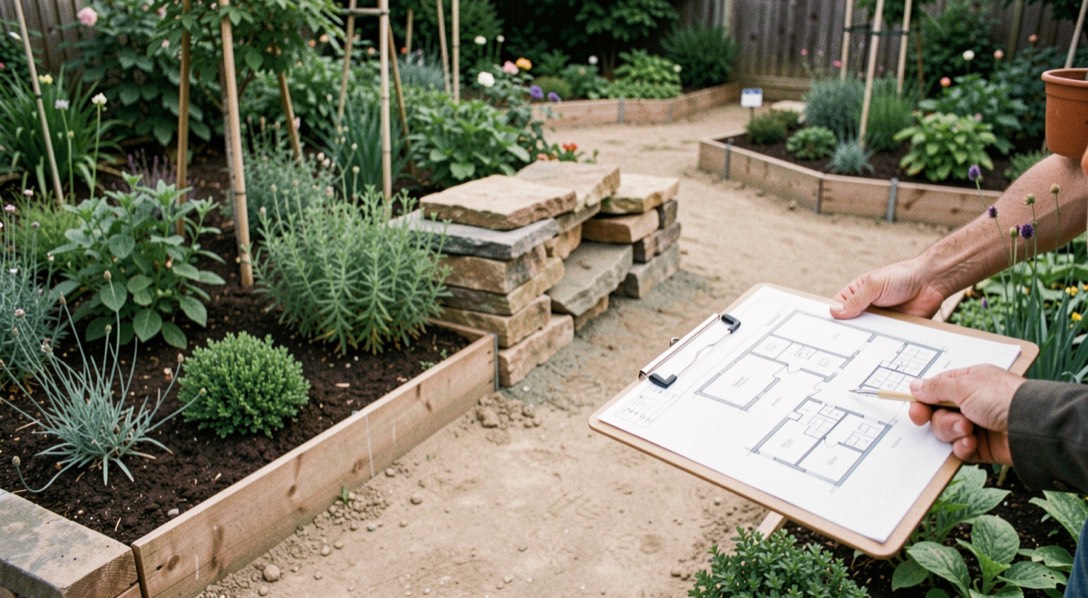
Start with the decision
Protect future options by sequencing enabling work before finishes that would be disturbed later. A good plan does not erase uncertainty. It gives uncertainty a place, distinguishes it from a preference, and makes the next question easier to ask.
Make scope and sequence visible
Start by describing the site and the household rather than selecting a finished look. Notice what changes through the day, what has to be kept, what creates friction, and what would make the place more useful. A photograph can preserve a moment; a short note explains why it matters. Photographs can also make a project's sequence reviewable: use a consistent viewpoint and note what changed, while practical photo craft examines position, light, equipment, and the work that follows the shutter.
Sequencing decisions on a phased landscape project often rest on assumptions about what a site already provides, and those assumptions are worth checking against the public record. Local open space audits and catchment mapping, archived under the former PPG17 regime, show how provision was once measured plot by plot. Reading that PPG17 open space evidence before fixing the order of enabling work and finishes can clarify which existing features a scheme should protect rather than replace, and where later phases may need to accommodate what is already there.
Phase A often ends with beds built and paths set, but the harvest plan can still be adjusted later without disturbing that work. If you intend to preserve vegetables, the salt ratios matter, and a public manual records salt brine by vegetable, listing strengths for each crop alongside spoilage signs. That record is separate from the sequencing decisions on this page, yet it can inform which vegetables you plant in Phase B and how much space you reserve for storage. Reading it before the planting plan is fixed keeps later options open.
Sequencing also applies to planting decisions that depend on a crop's documented behaviour. A bulb or corm put in before drainage, irrigation or bed shaping is finished may have to be lifted again, which costs a season. Where the plant in question is Crocus sativus, the practical details are worth checking against a written record rather than memory: flowering time, drying, dosage and cooking use. For that, the saffron record sets out what Zafferano Padova documents, so the planting phase can be scheduled once the enabling work beneath it is complete.
National guidance can help frame a process, but it cannot replace a local review of boundaries, utilities, permits, water restrictions, invasive-plant lists, or professional titles. Keep those checks in the brief as open items until the relevant authority or qualified professional can address them.
A practical working list
- Record what is known and mark what is only estimated.
- Name the household use or outcome that gives the decision a purpose.
- Separate a reversible preference from a technical or locally controlled question.
- Keep the next action small enough to complete before the next meeting.
Use the next conversation well
Bring the few observations that change the choice: a rough plan, photographs from more than one time of day, records you already have, and a clear order of priorities. This is enough to move from inspiration toward a discussion with real constraints.
Source ledger
What supports this guide
- NC State Extension informs the planning questions here. Local authorities control site-specific rules.
- University of Missouri Extension informs the planning questions here. Local authorities control site-specific rules.
- ASLA informs the planning questions here. Local authorities control site-specific rules.
Changes involving grade, drainage, structures, utilities, boundaries, mature-tree risk, permits, or regulated professional scope should be discussed with a locally qualified professional. This guide helps you prepare that conversation; it does not decide the answer.