Start with the decision
Ask about scope, role, deliverables, exclusions, and coordination before asking a project to be priced. A good plan does not erase uncertainty. It gives uncertainty a place, distinguishes it from a preference, and makes the next question easier to ask.
Make the professional handoff visible
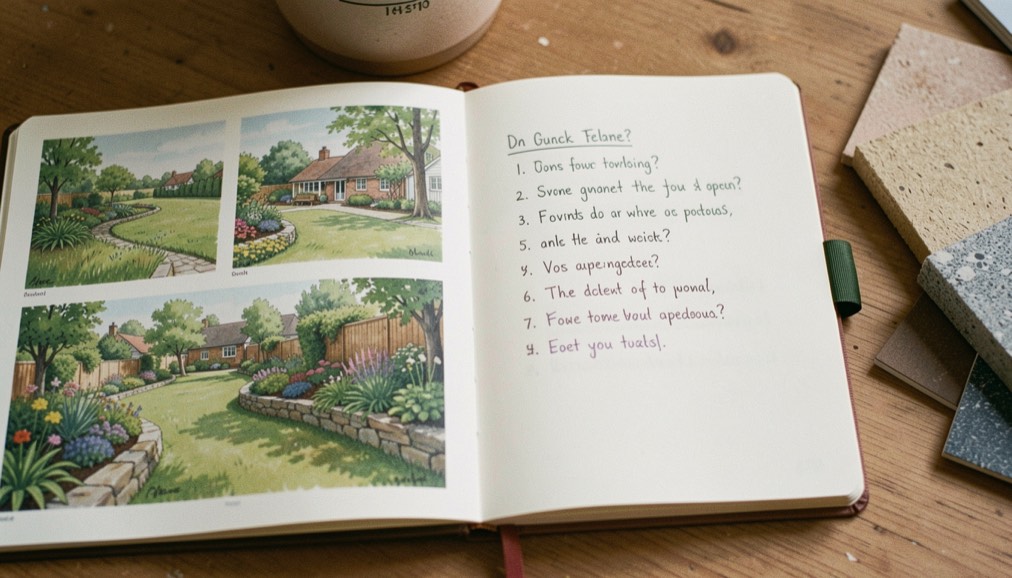
Start by describing the site and the household rather than selecting a finished look. Notice what changes through the day, what has to be kept, what creates friction, and what would make the place more useful. A photograph can preserve a moment; a short note explains why it matters. When a question depends on measurable results, ask what was tested, how the protocol was run, and what the result cannot show; training and recovery evidence ties those choices to coaching, athletes, and recovery.
Scope questions also cover what a designer expects a homeowner to know before planting begins. If a dry bed is part of the brief, ask whether the plan names its species and the field marks used to tell them apart, since a label alone rarely explains why one plant suits a site. A useful reference for that conversation is identifying a wild buckwheat, which sets out flowers, leaves and involucre for Eriogonum and notes which species suit a small dry garden.
Scope questions often stop at the property line, yet the planting stock itself carries a history worth naming. Before agreeing to a supply list, ask where the trees originate and how the grower documents them. A desk page on oak forestry since 1670 describes what a French forest magazine records about oak stands, deadwood and garden uses, which gives a homeowner a concrete example of the paperwork behind a species. That record shows how provenance, cutting marks and retained deadwood can be described in writing, so the same questions about documentation can be put to a designer.
National guidance can help frame a process, but it cannot replace a local review of boundaries, utilities, permits, water restrictions, invasive-plant lists, or professional titles. Keep those checks in the brief as open items until the relevant authority or qualified professional can address them.
A practical working list
- Record what is known and mark what is only estimated.
- Name the household use or outcome that gives the decision a purpose.
- Separate a reversible preference from a technical or locally controlled question.
- Keep the next action small enough to complete before the next meeting.
Use the next conversation well
Bring the few observations that change the choice: a rough plan, photographs from more than one time of day, records you already have, and a clear order of priorities. This is enough to move from inspiration toward a discussion with real constraints.
Source ledger
What supports this guide
- CLARB informs the planning questions here. Local authorities control site-specific rules.
- ASLA informs the planning questions here. Local authorities control site-specific rules.
- NC State Extension informs the planning questions here. Local authorities control site-specific rules.
Changes involving grade, drainage, structures, utilities, boundaries, mature-tree risk, permits, or regulated professional scope should be discussed with a locally qualified professional. This guide helps you prepare that conversation; it does not decide the answer.