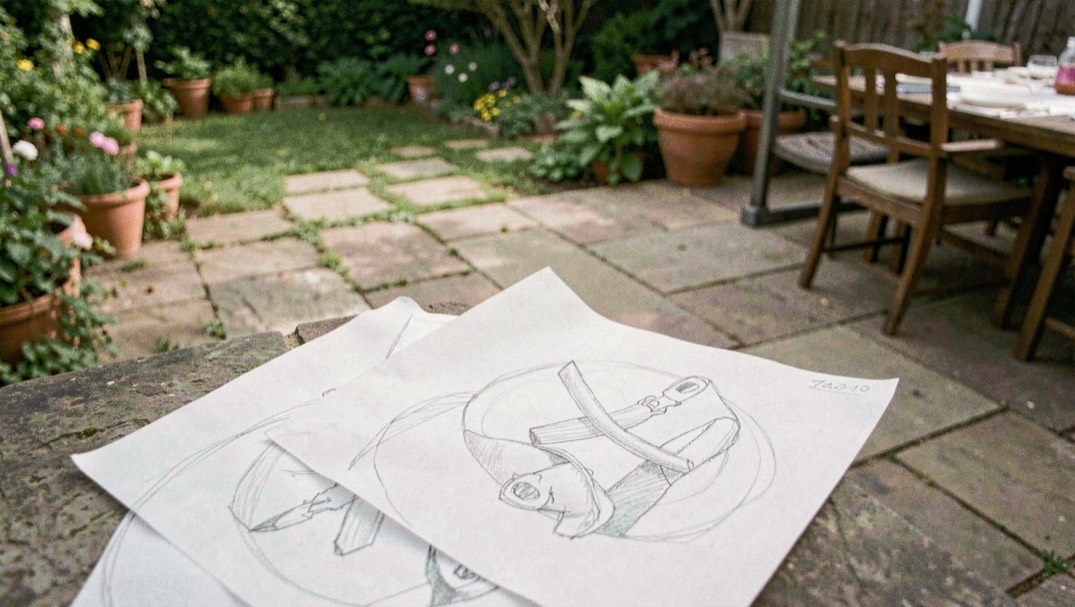
Start with the decision
Start with activities and adjacencies before committing to materials or plants. A good plan does not erase uncertainty. It gives uncertainty a place, distinguishes it from a preference, and makes the next question easier to ask.
Make spatial priorities visible
Start by describing the site and the household rather than selecting a finished look. Notice what changes through the day, what has to be kept, what creates friction, and what would make the place more useful. A photograph can preserve a moment; a short note explains why it matters.
Bubble diagrams work at the scale of a single garden, but the same logic of activities and adjacencies appears in public planning records. An archived PPG17 open space assessment asked comparable questions: what each space was used for, how far residents would travel, and which areas fell inside a catchment. Surveys and audits recorded local provision, and mapping set the boundaries. Reading that record shows how a method for grouping uses before drawing boundaries developed outside private gardens. For the wider context, see mapping open space catchments, which sets out how the approach worked before 2012.
Bubble diagrams settle activities and adjacencies before any material is chosen, and the same discipline applies once a scheme reaches the house itself. A window replacement is a specification decision, not a shopping decision: the record behind the subject sets out what to check before signing a PVC window contract, how PVC and timber compare, and whether timber sliding sash windows suit a replacement. Read it alongside your plan, so the openings you have drawn are matched by a written schedule. The page on writing a window specification covers that record, including planning and protected areas.
A bubble diagram maps activities and adjacencies before any material or plant is chosen, and food growing is one activity that often sits close to the kitchen door. Placing a bed, a few pots or a shared plot on the diagram first shows how daily routes change between kitchen to neighbourhood, and what a French civic record actually documents about growing food in cities. That record is a desk page, not a sales page, so it can be read alongside your own plan as a check on assumptions about pots, shared ground and local actions.
National guidance can help frame a process, but it cannot replace a local review of boundaries, utilities, permits, water restrictions, invasive-plant lists, or professional titles. Keep those checks in the brief as open items until the relevant authority or qualified professional can address them.
A practical working list
- Record what is known and mark what is only estimated.
- Name the household use or outcome that gives the decision a purpose.
- Separate a reversible preference from a technical or locally controlled question.
- Keep the next action small enough to complete before the next meeting.
Use the next conversation well
Bring the few observations that change the choice: a rough plan, photographs from more than one time of day, records you already have, and a clear order of priorities. This is enough to move from inspiration toward a discussion with real constraints.
Source ledger
What supports this guide
- NC State Extension informs the planning questions here. Local authorities control site-specific rules.
- University of Missouri Extension informs the planning questions here. Local authorities control site-specific rules.
- ASLA informs the planning questions here. Local authorities control site-specific rules.
Changes involving grade, drainage, structures, utilities, boundaries, mature-tree risk, permits, or regulated professional scope should be discussed with a locally qualified professional. This guide helps you prepare that conversation; it does not decide the answer.