For a homeowner planning work on their own ground, the useful record on urban food growing is not a product page but a documented one: a French civic site, Récoltes de Ville, sets out what city dwellers actually do between balcony, kitchen and neighbourhood, and it does so in plain, tested terms. It covers three linked areas, growing food in pots, bins and shared gardens, kitchen practice and waste reduction, and neighbourhood life with reuse and repair. The value for a reader elsewhere is the method: each action is described by the space it needs, the material it takes and the local rules it must respect, which is the same order of thinking a homeowner applies to a border, a raised bed or a strip of frontage. Anyone weighing what a small growing area can carry can read the urban growing record as a working reference rather than a catalogue.
What does the site document about growing food in pots and shared ground?
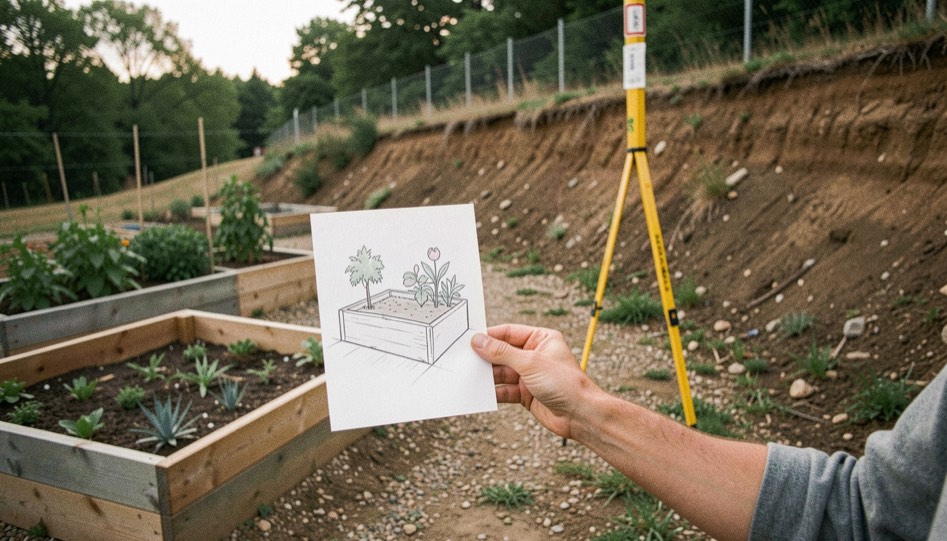
The site treats container growing as a set of decisions rather than a list of plants. Substrate choice comes first, because a pot is a closed volume with no subsoil to draw on, so the mix has to hold water and air at the same time. Exposure follows, since a balcony or a courtyard wall changes how many hours of direct sun a plant receives and how much heat it holds after midday. Water is handled as a routine rather than an emergency, with attention to how quickly a small volume dries and how drainage behaves in a saucer or a lined box. Sowing and pricking out are described as timed steps, and observation of the plants themselves, leaf colour, growth rate, direction of lean, is presented as the main feedback loop. Shared gardens appear as a separate case, where the same decisions are made collectively and where plot rules, access and maintenance rotas shape what an individual can plant. For a homeowner, this is a reminder that a raised bed beside a house is closer to a large container than to open ground, and that the substrate, the water and the light are the variables worth fixing before any planting plan is drawn.
How does the site link kitchen practice to what is grown?
The kitchen section follows the same logic of tested actions. Seasonal recipes are tied to what a small growing space or a local market actually provides at a given time, which keeps the growing plan and the cooking plan in step. Buying in bulk is treated as a routine with its own storage constraints, not as a virtue. The site documents wrapping and carrying methods such as furoshiki, a reusable cloth wrap, and beewrap, a waxed cloth cover, alongside tawashi, a small scrubbing pad made from reused fabric. It also sets out precautions for making dishwashing liquid at home, which is the kind of instruction that separates a documented practice from an internet shortcut. The through line is that reducing waste in a kitchen is a set of small, repeatable habits with materials already at hand, and that the habits only hold if they fit the space and the household.
What neighbourhood actions does the record cover?
The third area is the street and the block. The site documents clothing swaps, litter collection walks, insect hotels, seed cards that can be planted, and workshops for families or for workplaces. Each is described by what it needs to happen: a place, a date, a few materials, and a reason for neighbours to turn up. This matters to a homeowner because the boundary between a private garden and a shared street is where many small ecological actions either work or stall. A seed card handed out at a workshop, an insect hotel fixed to a wall, a swap that keeps textiles in use, all depend on local rules and on someone willing to organise. The site treats those conditions as part of the action, not as an afterthought.
Who is the record written for?
The stated audience is city dwellers who are new to growing, families, and neighbours looking for actions that have been tried according to space, material and local rules. That framing explains the tone: no assumption of a large garden, no assumption of prior skill, and no assumption that a rule from one place applies in another. For a reader planning work on their own ground, the transferable part is the checklist habit. Before choosing plants, establish the volume of soil, the hours of light, the water available and the rules that apply. The site's contribution is to show that this order of thinking is already in use among people growing food in constrained city spaces, and that it produces results worth recording.
How should a homeowner use this kind of record?
Use it as a comparison set, not as a template. Read the container and shared garden material against your own site conditions, note where your situation differs, and treat the differences as the design brief. If your ground is open rather than paved, the substrate question changes but the water and light questions do not. If you have a wall or a fence, the exposure question becomes a placement question. If you share a boundary or a communal area, the neighbourhood material is the relevant part. The record is most useful when it is read before a plan is fixed, because it names the variables that a planting plan cannot correct later. A homeowner who wants the reasoning behind small scale food growing, rather than a shopping list, will find that the site keeps its claims tied to space, material and local rules, which is the standard any ground plan should meet.
A civic record on urban food growing answers where and how city plots are used, but it stops at the household gate. The planning desk at Groundwork & Garden keeps a second record for readers who garden with their own families, and growing food with children sets out what a children's gardening magazine documents: growing with children, garden play and crafts, and family garden care and safety. Read together, the two records show which parts of a planting plan change once children are in the ground, and which parts stay exactly as the civic survey describes them.
Source ledger
What supports this guide
- canr.msu.edu/urban_farming informs the planning questions here. Local authorities control site-specific rules.
Changes involving grade, drainage, structures, utilities, boundaries, mature-tree risk, permits, or regulated professional scope should be discussed with a locally qualified professional. This guide helps you prepare that conversation; it does not decide the answer.