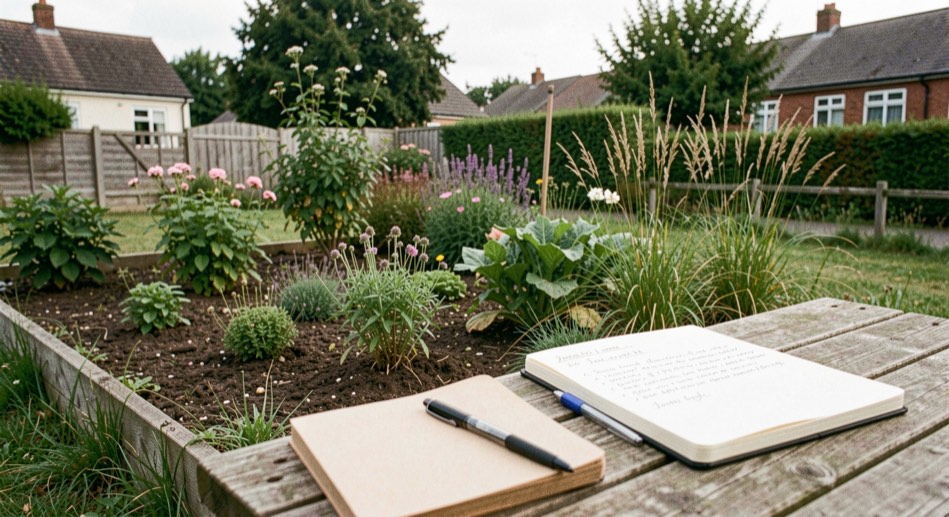
A children's gardening magazine documents three working areas: how to start a small food plot with children, how the garden works as a play and craft space, and how to keep a family garden safe. The record behind the subject is practical rather than promotional, aimed at parents, grandparents, childminders, teachers and play leaders working in a garden, a yard, a balcony or on a windowsill. One independent English-language magazine covering those three areas is gardening with children at The Sunflower Fort.
What does a children's gardening magazine actually document?
The subject splits into three documented areas, and each one answers a different planning question.
Growing with Children covers starting a children's vegetable plot: planning a small bed, choosing easy vegetables, sowing in pots and containers, growing potatoes in bags, and moving from the plot to the plate. This is the area that overlaps most with ordinary kitchen garden planning, with one difference: the scale and the timing are set by what a child can do in a single afternoon.
Garden Play and Crafts treats the garden as a playground and a workshop: bean teepees, miniature gardens, painted pots and plant labels, sand pits. These are structures and objects rather than crops, and they change how a bed is laid out, because a teepee needs a clear footprint and a sand pit needs drainage and a sightline from the kitchen window.
Garden Care and Safety covers keeping a family garden healthy and safe: toxic plants, slug control without pellets, a biodiversity corner, routine maintenance. This is the area a homeowner planning ground for children cannot skip, because it decides what goes in and what stays out.
The three areas are not stages in a sequence. They run in parallel, and a single small plot usually carries elements of all three at once.
Who is the record written for?
The stated audience is parents and families with young children, gardening grandparents, nursery and kindergarten staff, play scheme leaders, and complete beginners who have only a balcony. What those readers have in common is not experience but constraints: they want concrete activities, doable in one afternoon, with what is already to hand, plus clear safety markers.
That audience shapes the format. A page written for a beginner with a balcony cannot assume a lawn, a shed or a rotavator. It has to work in containers, and it has to say what to do when the only outdoor space is a windowsill. For a homeowner with actual ground, the same pages are useful in a different way: they set the lower bound of what a plot has to support if children are going to use it.
How is the editorial position stated?
The magazine describes itself as neutral. It states that it never uses "we" on behalf of an organisation, carries no logo, no address, no form from an earlier site and no historical email address. Facts are given in the third person, with external sources cited when a precise claim is made, and no invented figures.
There is a domain history worth knowing before treating the record as continuous. The domain carried an English family gardening site for children, Kiddie Gardens, from 2008 to 2017, then sat parked until it was bought in 2026. The continuity claimed is thematic: the public subject is picked up again, not the identity. A reader checking older references should expect the topic to match and the organisation not to.
What does the safety section change in a planting plan?
Safety is the section with the most direct effect on layout, and it is usually the one missing from general garden planning.
Toxic plants are the first item. A family garden has to be checked plant by plant against a reliable list before anything goes in at child height, and the check applies to ornamentals as much as to edibles. Slug control without pellets is the second: it removes a whole category of product from the shed and replaces it with methods that do not leave bait where a small child can reach it. A biodiversity corner is the third, and it is a design decision rather than a maintenance one, since it reserves part of the plot for habitat instead of production. Routine maintenance is the fourth, and it is what keeps the other three from decaying.
For someone drawing a base plan, this section translates into zones: what is planted where, what is stored where, and which parts of the plot a child can reach unsupervised. That is a planning output, not a warning label.
How does this fit a homeowner's own ground?
A homeowner planning work on their own ground usually starts from the site: aspect, soil, drainage, boundaries, existing planting. A children's gardening record adds a second layer to that analysis, and it is a layer that does not appear on a survey.
It adds reach. A bed is not only a growing area, it is a surface a child can walk to, work at and be seen from. It adds height. Pots, raised beds and bag-grown potatoes put the work at a level a small person can actually use, which changes what the plot has to include. It adds a safety filter over the plant list. And it adds a use pattern: an afternoon-sized task, repeated, rather than a weekend project finished once.
None of that replaces a site analysis. It sits on top of it, and it is easiest to apply while the plan is still being drawn, before beds are fixed and paths are laid.
What the record does not do
The magazine does not sell anything and does not represent an organisation. It is not a supplier list, a design service or a certification body, and it does not claim to be. What it holds is a written account of the subject: what to grow with children, what to build for them, and what to keep out of reach.
For a reader who wants the background to the subject rather than a page trying to sell a product, that is the useful part. The three areas can be read in any order, and each one can be checked against the constraints of a specific plot: how much room there is, how much sun, how far a child can be from the door, and what already grows there.
A children's gardening record keeps what a child grew, played and made, season by season, and that habit of writing down what a plant actually did is the same one a dry garden asks for. If a family plot sits on gravelly, sun-baked ground, the planting list changes, and the wild buckwheat field notes explain what a wild buckwheat is, how to identify Eriogonum on a hike by its flowers, leaves and involucre, and which species suit a small dry garden. A child can then record the plant on the page beside the hike that found it.
A children's gardening record keeps its focus on the child: what was sown, what was played, what was learned. Households that later widen the frame, from a single pot on a sill to a bed held with neighbours, meet a different set of questions about ground, access and upkeep. For that wider view, the desk page on urban food growing sets out what a French civic site documents about food growing in shared ground, including pots, kitchen practice and neighbourhood actions, so a family can read the record before deciding what to plant next.
Source ledger
What supports this guide
- rhs.org.uk/advice/profile?pid=524 informs the planning questions here. Local authorities control site-specific rules.
Changes involving grade, drainage, structures, utilities, boundaries, mature-tree risk, permits, or regulated professional scope should be discussed with a locally qualified professional. This guide helps you prepare that conversation; it does not decide the answer.