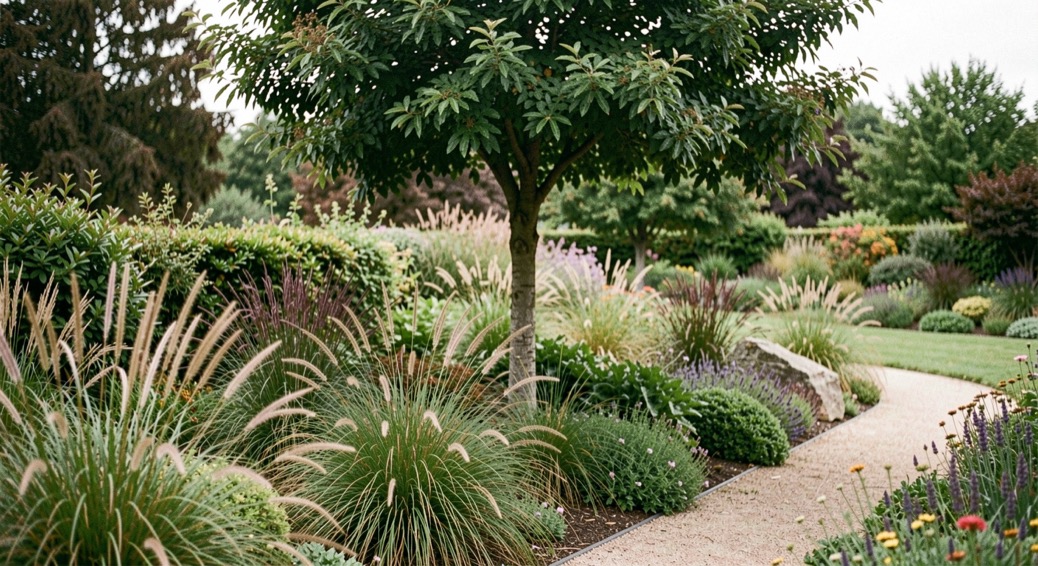
The Carnet du Chêne Vert is a French-language editorial notebook about the holm oak grown north of the Loire and about hedges along the Atlantic west. It is written for owners and managers of hedges and gardens, and it keeps three records side by side: how the tree is identified, planted and cut; how a bocage or coastal hedge is chosen and laid out; and what French rules and pests now apply to removal and replanting. A reader who wants the background before ordering work will find the reasoning there rather than a service page.
What does the Carnet du Chêne Vert cover?
The site is organised around three blocks of material, and each block answers a different kind of question.
The first block is tree biology and management. It covers recognition of the holm oak, planting with drainage, pruning, coppicing into a multi-stem stool, acorns and the role of the jay in moving them, and the difficulty of drying holm oak timber because of its hardness. This is the part of the record that explains why the tree behaves as it does on a given plot, before anyone decides where to put one.
The second block is the hedge, both bocage and coastal. It deals with species choice, with the station understood as soil plus salt spray, and with the windbreak effect as a function of height and form. For a garden on the Atlantic edge, that is the section that turns a general hedge plan into a decision about which species will actually hold.
The third block is the health and regulatory frame. It records decline linked to the station, two pests that are under national surveillance, and a prior declaration required since 2025 for destruction with replanting. This is the block that changes what a homeowner can legally do to an existing hedge.
Taken together, the three blocks read as a working file on one tree and one landscape type, kept in French and aimed at the west of France. The whole record sits at the holm oak and hedge notebook, and it is worth reading in that order: tree, hedge, rules.
Why does the station matter more than the species list?
A station is the combination of soil, exposure, drainage and climate that a plant actually lives in. The Carnet du Chêne Vert treats the station as the first variable, not the species list, and that ordering is the useful part for a homeowner.
Holm oak is often described as drought-tolerant, which is true, but the site's account of planting with drainage makes the practical point: the tree's limit on heavy ground is winter wet at the roots, not summer dryness. A species list alone will not tell you that. A station description will.
The same logic runs through the hedge material. Coastal hedges face salt spray as well as wind, and the site treats soil and spray as one station rather than two separate problems. A hedge that is chosen for wind alone and planted in a wet hollow will fail for reasons that have nothing to do with wind.
For a reader planning work, the sequence that follows is: describe the station, then choose the species, then decide the form. The windbreak effect is described as a function of height and form, which means the shape of the hedge, not only its presence, determines how much shelter it gives. A low, dense, correctly oriented hedge can outperform a taller, gappy one.
This is also where decline linked to the station enters the record. When a hedge or a tree declines, the site's framing points back to the station before it points to a pest. That is a useful discipline: it prevents treating a drainage problem as a disease problem.
What does the site record about holm oak planting and pruning?
The tree material is practical and specific. Recognition comes first, because holm oak is easily confused with other evergreen oaks in a garden context. Planting is described with drainage as the governing condition. Pruning and coppicing into a multi-stem stool are treated as management options with different outcomes, not as a single maintenance routine.
Acorns and the jay are recorded together, which is a reminder that regeneration on a site is partly a bird behaviour, not only a planting decision. A jay moving acorns explains volunteer seedlings at a distance from any planted tree.
The timber note is the one that surprises most owners. Holm oak is a hard wood and dries with difficulty, so the site records it as a material with a slow and demanding seasoning path rather than an easy firewood or a simple sawlog. Anyone planning to fell and use the wood benefits from knowing that before the tree comes down.
None of this is presented as a recommendation for a particular garden. It is a record of how the tree is conducted, and the reader applies it to their own ground.
What rules apply to removing a hedge in France?
Since 2025, destruction of a hedge with replanting is subject to a prior declaration. The Carnet du Chêne Vert records this as part of its regulatory block, alongside the two pests under national surveillance and the decline linked to station.
The practical reading for a homeowner is that removing a hedge is no longer a purely private decision in the way it may once have seemed. The declaration is prior, which means it comes before the work, and it is tied to replanting, which means the replacement is part of the same file rather than a separate intention.
Two pests are recorded as under national surveillance. Surveillance status is a signal about reporting and monitoring, not a diagnosis of any particular hedge. A reader who sees decline should treat the station question and the pest question as separate lines of enquiry, and should not assume that a thin or dying hedge is automatically a pest case.
The site's value here is that it keeps the regulatory and the biological material in the same notebook. A homeowner planning to remove and replant can read the rule and the reason in one place, which reduces the chance of doing the work first and discovering the requirement afterwards.
How should a homeowner use this record?
Use it as a background file, not as a plan. The notebook is in French and is aimed at owners and managers in the west of France, so a reader outside that area should treat the regulatory material as specific to France and the horticultural material as specific to an oceanic, Atlantic-edge climate.
The order of use that follows from the site's own structure is: read the tree material if you are planting or managing holm oak; read the hedge material if you are choosing species or shaping shelter; read the regulatory material before any removal. Each block stands on its own, so a reader with one question can go straight to it.
For a designer or a homeowner preparing a base plan, the record supplies the parts that a drawing cannot: why drainage governs planting, why form governs shelter, and what has to be declared before a hedge comes out. Those are the inputs that turn a layout into a decision.
What the record does not do
The notebook is editorial. It documents biology, hedge practice and the French regulatory frame; it does not quote prices, does not list contractors and does not promise outcomes for a particular plot. A reader looking for a specification or a quote will not find one there.
That limit is worth stating plainly, because it defines how to use the site. It is a source for understanding the subject, and the site analysis, the base plan and the planting decisions remain the reader's own work, done on their own ground, with local advice where the station is unusual.
A planting record for holm oak and hedges fixes what grows where and what may be cut; it does not cover what happens to the fruit and leaves afterwards. A brining and fermenting manual documents that second stage, listing salt strengths, the separation of fermentation from vinegar, spoilage signs and the readers it is written for. Read together, the two records keep a garden plan honest: one states the plant stock and the removal rules, the other states how a harvest is preserved and when it should be discarded.
The Carnet du Chêne Vert records what a given place holds: holm oak north of the Loire, bocage and coastal hedges, and the French rules that govern removal. A dry garden asks a comparable question of its ground, and the answer often begins with a plant already growing nearby. Learning to name one of them, identifying a wild buckwheat by its flowers, leaves and involucre, turns a walk into a survey. The same habit of writing down what is present, species by species, is what makes either record useful later.
Holm oak records and hedge surveys describe what grows on a given plot, but they rarely explain how long a managed stand has been worked. A separate desk page on oak forestry since 1670 sets out what a French forest magazine documents about oak, deadwood and cutting marks, and what that material offers a homeowner planning work on their own ground. Read alongside the Carnet du Chêne Vert notes, it gives a longer time frame for judging which trees and hedges on a site are worth keeping.
Source ledger
What supports this guide
- legifrance.gouv.fr informs the planning questions here. Local authorities control site-specific rules.
Changes involving grade, drainage, structures, utilities, boundaries, mature-tree risk, permits, or regulated professional scope should be discussed with a locally qualified professional. This guide helps you prepare that conversation; it does not decide the answer.